

Article

Key strategic factors when choosing distributors and partners

Distribution strategy

Companies that are expanding, or trying to become more efficient, can gain a lot from looking at their distribution strategy as a combination of three main ways to expand, and at how these work together.

• Geography: Expanding into new countries or regions.

• Business areas: Expanding into new business areas.

• Product: Expanding through new products or product variants.

Each method has its pros and cons, and they can be combined in different ways depending on the company’s business model and potential market.

Consider the figure below. It shows a company’s total expansion potential across the three methods, and it is very useful when you evaluate new expansion partners such as distributors. The matrix can of course be extended with more business areas, geographies and products.

A geography represents a country or a specific region, and a business area can be, for example, a certain type of customer or an industry with specific product or business requirements.
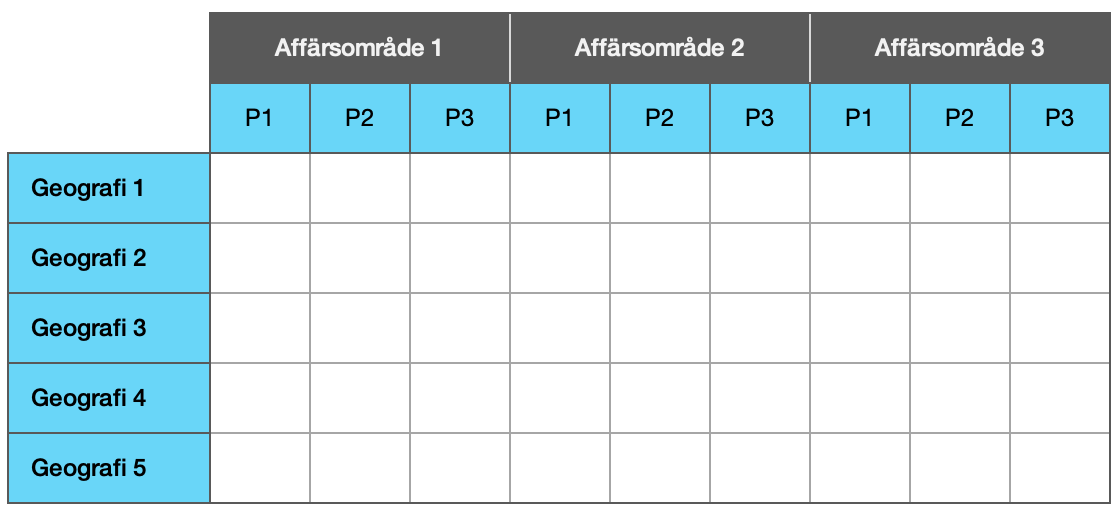
Expansion matrix: geographies, business areas and products

Ideally, the whole matrix would be filled with a reasonable number of well-performing distributors. Enough to keep the risk low, and few enough to keep the administration manageable. Companies with their own distribution capacity will probably want to cover some parts of the matrix themselves, such as the home market.

Distributors often overlap. One distributor might be able to sell a specific product in several countries, while another could sell all products, or serve all business areas, in one specific country.

Sometimes an overlap is desirable, but it can also mean giving up the chance to work with a particularly valuable distributor, since such distributors often want exclusivity. The shaded area in the figure below shows a potential conflict between two types of distributors, one with a broad product range and one with broad geographic coverage.
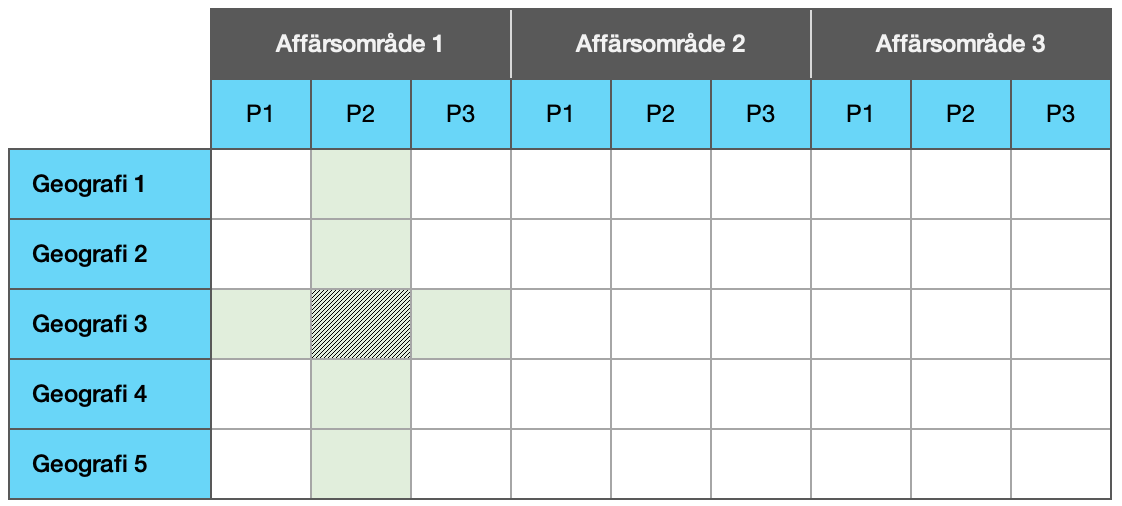

Expansion matrix with overlapping distributors
Here are some key factors to consider when you develop a distribution strategy, or negotiate with a new distributor.
• First, check whether there are general factors specific to your product or business model that affect the sales strategy. For example, whether you need a local support or sales organization, or whether different regulations apply. If you have your own distribution capacity, evaluate both that capacity and the opportunity cost compared with distributing yourselves.
• Are there attractive distributors in the market that will want exclusivity? If so, be careful about which rights you give to less attractive distributors that you sign before them. One approach is to analyze the players in the market and fill in an expansion matrix like the one above for the most attractive distributors.
• In a negotiation, find out which distribution rights each potential distributor will actually be able to use successfully in the market, and avoid giving rights that are only nice to have.
• Never grant exclusivity unless the distributor has high capacity, and always set performance requirements so that a market cannot be blocked. If you are unsure about a distributor, start with a shorter agreement. Smaller distributors can be signed without exclusivity.
• Do not aim for perfection. A lot can happen, and a secure deal is worth much more than a potential future deal, even if the future deal has more potential. You will probably not be able to fill the whole matrix in an optimal way, and that is perfectly fine.

Looking for strategic advice? Read more here >>

We'd be happy to hear from you

If you have any questions or are simply curious to know more about how we can help, you are very welcome to get in touch.